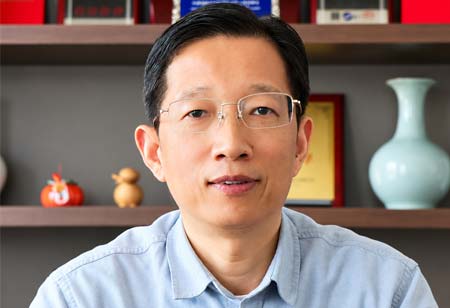
Tao Yang is the General Manager of HISHING (Qingdao Hishing Smart Equipment Co., Ltd.), a high-tech enterprise founded in 2007 specializing in sustainable aquaculture and livestock equipment, intelligent egg counting and IoT-based farming management systems.
For a modern layer or breeder farm, the difference between profit and loss often comes down to a deceptively simple metric: how many intact eggs reach the packing line. An egg that cracks on the collection belt or one that is miscounted at the end of the day, is revenue lost in silence. At HISHING, we built our AI vision egg counting and collection control systems around one conviction, every egg should be seen, counted and moved as efficiently as possible.
The cost of counting eggs the old way
For decades, egg counting relied on laser or photoelectric sensors that counted eggs in a line and on manual tallies that were slow, inconsistent and blind to what was actually happening inside each house. Farms could not easily tell which house was underperforming, when a belt was clogging or why breakage spiked on a particular day. The data simply was not there. Our customers told us the same thing again and again: they wanted real, per-house visibility, not an end-of-day total.
What we built: from a counter to a coordinated system
We addressed this with two connected products. The first is the HS-1201C AI vision egg belt counter, an integrated control host that combines a 13.3-inch industrial touchscreen, a built-in power module and a built-in PoE industrial switch inside a single IP65-rated enclosure. One host can manage up to 250 channels of AICE1201 AI egg belt counters across an entire farm, performing real-time object detection, counting and data reporting over RTSP video streams. Built on deep-learning vision algorithms, it achieves a single-unit recognition accuracy of 99.9 per cent or higher and reliably tallies total eggs while distinguishing dirty and blood eggs in real time.
The second is our intelligent egg collection control system. It takes the counting data from every house and closes the loop: by continuously calculating each house's laying rate and the total collection speed on the main belt, the system uses variable-frequency drives to adjust conveyor speed and start/stop timing so that collection flow stays at the optimal value. The result is measurably lower breakage, higher collection efficiency and a shorter total collection time.
The value our clients actually see
The value is not in the hardware, it is in what the hardware lets a farm manager do. Our system gives customers:
• True per-house visibility. Every house, every tier, every column is monitored independently, with egg counts updated in real time. A manager can see at a glance which house is underproducing, without walking the whole facility.
• Precision through recipes. Farms pre-configure multi-stage collection recipes, step sequence, run duration and frequency and switch between them as production patterns shift. This evens out output and prevents conveyor congestion or idling.
• A complete data chain. Minute-level timestamps record each house's egg volume, total volume and running time; historical queries and trend curves let managers trace daily output, average flow and anomalies back through time.
• Proactive maintenance, not reactive repair. Real-time alarms with sound and light alerts, plus historical alarm records, shift farms from “fix it when it breaks” to preventive maintenance driven by actual fault patterns.
• Scale without added complexity. Because the architecture is master–slave and distributed, a single point of failure does not take down the whole farm and standardized Modbus TCP industrial Ethernet keeps everything talking even in the harsh, high-humidity environment of a real poultry house.

In practice, our counting system automates the management of 200,000 eggs a day with a farm-wide counting error rate of less than 0.1 per cent, enabling operators to move beyond eyeball estimates and work with precise, trustworthy data.
Beyond poultry: a system-level view of farming
This work sits inside a broader HISHING philosophy. Through our three subsidiaries, Qingdao Hishing Smart Equipment, Qingdao Hishing Electronics and Haiyongxing Aquatic Products, we design recirculating aquaculture systems, electronic automation and IoT management platforms, always with the same goal: integrate technology so that farms optimize resources, minimize environmental impact and maximize yield. Across projects, our IoT and big-data backbone has reduced average equipment failure rates and driven operating costs below industry norms.
What we want our customers to know
The next decade of livestock farming will be won by farms that can see their operations clearly and act on that visibility in real time. An egg counter is a pair of eyes; an intelligent egg collection control system is the farm manager's brain and hands working around the clock. If you are running a layer, breeder or mixed poultry operation and want to turn every egg into data you can act on, we would welcome the conversation.
For a modern layer or breeder farm, the difference between profit and loss often comes down to a deceptively simple metric: how many intact eggs reach the packing line. An egg that cracks on the collection belt or one that is miscounted at the end of the day, is revenue lost in silence. At HISHING, we built our AI vision egg counting and collection control systems around one conviction, every egg should be seen, counted and moved as efficiently as possible.
The cost of counting eggs the old way
For decades, egg counting relied on laser or photoelectric sensors that counted eggs in a line and on manual tallies that were slow, inconsistent and blind to what was actually happening inside each house. Farms could not easily tell which house was underperforming, when a belt was clogging or why breakage spiked on a particular day. The data simply was not there. Our customers told us the same thing again and again: they wanted real, per-house visibility, not an end-of-day total.
What we built: from a counter to a coordinated system
We addressed this with two connected products. The first is the HS-1201C AI vision egg belt counter, an integrated control host that combines a 13.3-inch industrial touchscreen, a built-in power module and a built-in PoE industrial switch inside a single IP65-rated enclosure. One host can manage up to 250 channels of AICE1201 AI egg belt counters across an entire farm, performing real-time object detection, counting and data reporting over RTSP video streams. Built on deep-learning vision algorithms, it achieves a single-unit recognition accuracy of 99.9 per cent or higher and reliably tallies total eggs while distinguishing dirty and blood eggs in real time.
The second is our intelligent egg collection control system. It takes the counting data from every house and closes the loop: by continuously calculating each house's laying rate and the total collection speed on the main belt, the system uses variable-frequency drives to adjust conveyor speed and start/stop timing so that collection flow stays at the optimal value. The result is measurably lower breakage, higher collection efficiency and a shorter total collection time.
-
The value is not in the hardware, it is in what the hardware lets a farm manager do.
The value our clients actually see
The value is not in the hardware, it is in what the hardware lets a farm manager do. Our system gives customers:
• True per-house visibility. Every house, every tier, every column is monitored independently, with egg counts updated in real time. A manager can see at a glance which house is underproducing, without walking the whole facility.
• Precision through recipes. Farms pre-configure multi-stage collection recipes, step sequence, run duration and frequency and switch between them as production patterns shift. This evens out output and prevents conveyor congestion or idling.
• A complete data chain. Minute-level timestamps record each house's egg volume, total volume and running time; historical queries and trend curves let managers trace daily output, average flow and anomalies back through time.
• Proactive maintenance, not reactive repair. Real-time alarms with sound and light alerts, plus historical alarm records, shift farms from “fix it when it breaks” to preventive maintenance driven by actual fault patterns.
• Scale without added complexity. Because the architecture is master–slave and distributed, a single point of failure does not take down the whole farm and standardized Modbus TCP industrial Ethernet keeps everything talking even in the harsh, high-humidity environment of a real poultry house.
In practice, our counting system automates the management of 200,000 eggs a day with a farm-wide counting error rate of less than 0.1 per cent, enabling operators to move beyond eyeball estimates and work with precise, trustworthy data.
Beyond poultry: a system-level view of farming
This work sits inside a broader HISHING philosophy. Through our three subsidiaries, Qingdao Hishing Smart Equipment, Qingdao Hishing Electronics and Haiyongxing Aquatic Products, we design recirculating aquaculture systems, electronic automation and IoT management platforms, always with the same goal: integrate technology so that farms optimize resources, minimize environmental impact and maximize yield. Across projects, our IoT and big-data backbone has reduced average equipment failure rates and driven operating costs below industry norms.
What we want our customers to know
The next decade of livestock farming will be won by farms that can see their operations clearly and act on that visibility in real time. An egg counter is a pair of eyes; an intelligent egg collection control system is the farm manager's brain and hands working around the clock. If you are running a layer, breeder or mixed poultry operation and want to turn every egg into data you can act on, we would welcome the conversation.